Curved Steel Staircase European Project: Box Beam Design and Modular Export

A curved steel staircase is often the centerpiece of high-end residential and commercial projects. Unlike a spiral, which rotates around a central axis, a curved staircase follows a gentle helical arc — typically between 90 and 180 degrees — offering a grand, sweeping visual that feels both sculptural and welcoming. In this case study, we walk through a European villa curved staircase project, including the box beam structure, honeycomb-reinforced treads, and bolted modular export design.
Project Overview
The client is a European architecture firm working on a luxury villa project. The brief called for a curved steel staircase spanning two floors, with a total rise of 4.2 meters and a 180-degree turn. The staircase needed to be fully prefabricated in our Foshan factory, shipped to the construction site, and assembled on site without any welding.
The design called for a double box beam stringer — one inside curve and one outside curve — connected by 6mm steel plate treads with honeycomb reinforcement for added stiffness. The railing was specified as frameless glass with a round stainless steel handrail.
Technical Specifications
| Parameter | Specification |
|---|---|
| Total rise | 4,200 mm |
| Turn angle | 180 degrees |
| Stringer | Double box beam, 10+10 mm steel plate |
| Tread thickness | 6 mm steel plate with honeycomb reinforcement |
| Railing | Frameless tempered laminated glass, 21.52 mm |
| Handrail | Round stainless steel, 50 mm diameter |
| Connection type | Modular bolted, no field welding |
Why Box Beam Stringers?
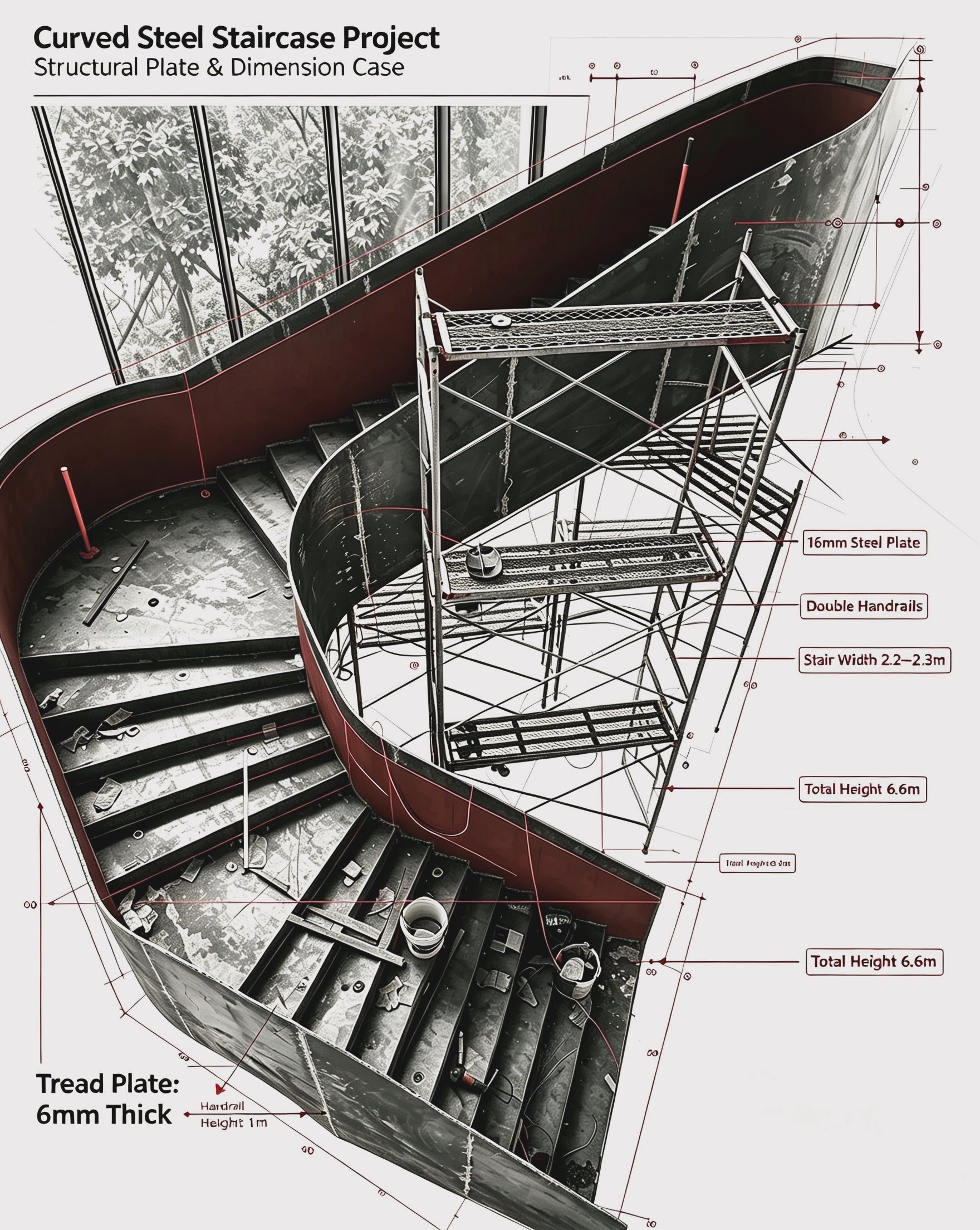
A curved staircase carries significantly more bending moment than a straight or spiral stair because the treads are cantilevered from the outside stringer over a longer span. A flat plate stringer would deflect noticeably under load. That is why we use a box beam — a hollow rectangular section formed by welding two 10mm steel plates together with internal stiffeners.
The box beam has far greater torsional and bending stiffness than a flat plate of the same weight. It allows the curved stringer to maintain its precise geometry across the full 4.2-meter rise without visible deflection, even under full occupancy loading. We specify a double box beam (inner and outer curves) so the entire tread frame acts as a rigid, self-supporting structure.
Honeycomb-Reinforced Treads
The treads are 6mm steel plates, but a 6mm plate across a 1.2-meter going would flex audibly when walked on. To solve this, we weld a honeycomb (hexagonal) reinforcement grid underneath each tread. The grid is made from 4mm steel strips, welded in place before the whole tread is powder-coated.
This construction achieves two goals simultaneously: it stiffens the tread to eliminate audible flex, and it keeps the visible face of the tread as a clean, flat 6mm plate — no visible stiffeners on the walking surface. The honeycomb design also reduces weight compared to a solid thicker plate, which matters for shipping and for the overall dead load on the building structure.
Modular Bolted Export Design
Because this staircase was destined for Europe, field welding was not an option. The client's installation team did not have certified welders on site, and on-site welding would have damaged the powder-coated finish. We designed the staircase as three bolt-connected modules:
- Lower module — bottom floor landing through the first 12 steps, shipped as one rigid unit
- Middle module — steps 13 through 24, with the curved glass railing panels pre-drilled
- Upper module — steps 25 through the top floor landing, including the top handrail transition
Each module interface uses M16 high-tensile bolts with locating pins. The pins align the modules before the bolts are torqued, ensuring that the curved stringer geometry stays true within ±1 mm across the full height. No on-site welding, no grinding, no touch-up paint required.
Export Packing and Logistics
For international shipments, every steel module is wrapped in anti-corrosion VCI film and packed in a custom plywood crate. Glass panels are packed in foam-lined wooden crates with edge protectors. Bolts, anchors, and small hardware are packed in a labeled parts bag, with a printed packing list and an installation QR code linking to video instructions.
This project was shipped in a 20-foot container from Guangzhou port to the European destination. Total shipping time was 28 days. On-site assembly by a local team of three took four days, with our engineer on a video call for the first two days to supervise alignment and bolt torquing.
What This Means for Your Project
If you are an architect, designer, or developer working on a luxury residential or commercial project abroad, a curved steel staircase can be fully designed, fabricated, dry-assembled, and shipped from China with confidence. The key is to specify bolted modular connections early in the design process, and to partner with a factory that has experience exporting to your destination country.
We regularly work with architecture firms across Europe, North America, Australia, and Southeast Asia, providing OEM fabrication to the client's own drawings. Send us your DWG or PDF drawings, and our engineering team will respond with a technical feasibility review and a factory quote within 48 hours.
TAKANO — Foshan custom steel staircase manufacturer, OEM for designers worldwide. WhatsApp: +86 180 2224 8038 | Email: takano.steel@outlook.com